Chicago Weather for Cyclists: Temperatures, Wind and Alert Levels
Chicago weather for cyclists from the National Weather Service: monthly highs and lows, snow and freezing days, wind and wind chill thresholds and heat alerts.
Chicago's riding months run from April to October, when average highs sit between 59.0 and 84.5°F1. Cold is the main limit: 121.3 days a year start with a low at or below 32°F1. Wind is the other. The National Weather Service issues a wind alert at sustained 30 to 39 mph or gusts of 45 mph2.
- At a glance
- Warmest month
- July, average high 84.5°F1
- Coldest month
- January, average high 31.6°F, low 18.8°F1
- Days with a high at or below 32°F
- 43.4 a year1
- Annual snowfall
- 38.4 inches1
- NWS wind alert
- Sustained 30 to 39 mph or gusts of 45 mph2
On this page
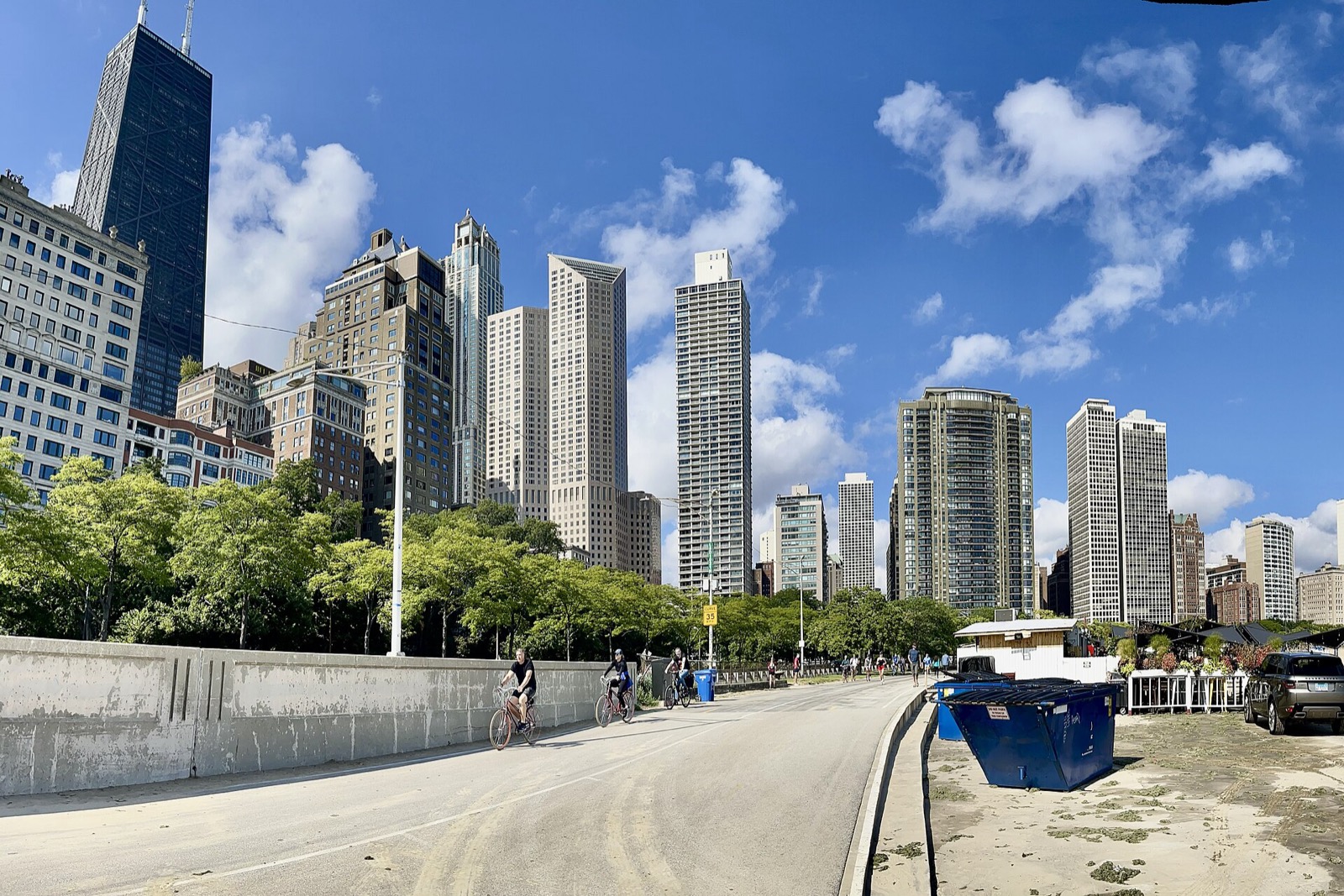
Chicago weather decides when you ride and how you dress. The numbers below come from the National Weather Service, which publishes the 1991-2020 climate normals for O’Hare and the alert levels that apply to the Chicago area1. This guide is part of Plan a Ride.
Temperatures by month
The normals cover 1991 to 20201. They give a clear season: a long cold stretch, a short warm one, and shoulder months that reward a jacket.
| Month | Average high | Average low | Precipitation | Snowfall |
|---|---|---|---|---|
| January | 31.6°F | 18.8°F | 1.99 in | 11.3 in1 |
| February | 35.7°F | 21.8°F | 1.97 in | 10.7 in1 |
| March | 47.0°F | 31.0°F | 2.45 in | 5.5 in1 |
| April | 59.0°F | 40.3°F | 3.75 in | 1.3 in1 |
| May | 70.5°F | 50.6°F | 4.49 in | trace1 |
| June | 80.4°F | 60.8°F | 4.10 in | 0.0 in1 |
| July | 84.5°F | 66.4°F | 3.71 in | 0.0 in1 |
| August | 82.5°F | 65.1°F | 4.25 in | 0.0 in1 |
| September | 75.5°F | 57.1°F | 3.19 in | 0.0 in1 |
| October | 62.7°F | 45.4°F | 3.43 in | 0.2 in1 |
| November | 48.4°F | 34.1°F | 2.42 in | 1.8 in1 |
| December | 36.6°F | 24.4°F | 2.11 in | 7.6 in1 |
The year averages 59.5°F for highs, 43.0°F for lows and 37.86 inches of precipitation1.
The riding season
April through October is the core season. Average highs run from 59.0°F in April to 84.5°F in July, and back to 62.7°F in October1. May is the month where highs first reach 70.5°F1. Rain is steady rather than seasonal: May, June and August each average more than four inches1.
Days at or above 90°F are few. There are 16.7 a year, and July has the most at 6.51. June has 4.1 and August has 3.71. The Weather Service’s heat index measures how hot it feels when relative humidity is added to the air temperature5. Its Chicago heat alert begins when the heat index is expected to reach or exceed 105°2. Ride early on those days.
Cold, snow and ice
Winter is the limit, not the exception. Highs stay at or below 32°F on 43.4 days a year1. January has 16.5 of them and February 11.21. Lows reach 32°F or colder on 121.3 days1. Lows fall to 0°F or colder on 6.5 days a year, mostly in January and February1.
Snow totals 38.4 inches a year, with 11.3 in January and 10.7 in February1. April still averages 1.3 inches, and October has a trace of 0.2 inches1. The Weather Service names “black ice” among short-term hazards, along with fog and sudden strong winds2. Frost advisories apply in the growing season2.
Wind chill
Wind chill is how cold people feel outside, and it applies to people and animals only4. At 0°F with a 15 mph wind, the wind chill is -19°F, and exposed skin can freeze in 30 minutes4. The index is defined only for temperatures at or below 50°F and wind speeds above 3 mph4. Bright sunshine can lift the wind chill by 10°F to 18°F4.
Frostbite needs air below freezing4. Above freezing, the risk is hypothermia from exposure to cold4. The Chicago office issues a Cold Weather Advisory for wind chills of -20 to -29°, and an Extreme Cold Warning for -30° or colder2. Do not ride at either level. For cold-season gear and routes, read the winter cycling guide.
Wind
The Weather Service publishes no cycling wind limit. It does publish alert levels. NWS Chicago’s Wind alert is sustained winds of 30 to 39 mph, or gusts of 45 mph or stronger, lasting at least one hour2. High Wind is 40 mph sustained for at least one hour, or gusts of 58 mph or more2. A severe thunderstorm is one capable of 50 knot (58 mph) winds2.
For a sense of the ordinary, the O’Hare report for September 2026 recorded an average wind speed of 8.1 mph3. The highest wind that month was 24 mph, and the highest gust was 32 mph3. That gust sits below the Wind alert level. Treat any day at or above that level as a day off the bike.
Visibility and the lake
Dense fog means visibility of a quarter mile or less across a wide area2. Ride with lights when that is forecast. The Weather Service also issues a Beach Hazards Statement when hazardous conditions are expected at beach and shore areas and adjacent surf zone waters2. The Lakefront Trail runs beside that shoreline, so check it before a lakefront ride.
What to check before you ride
Use three numbers: the forecast wind speed and gust, the wind chill if it is 50°F or lower, and the heat index in summer45. Compare them with the thresholds above. For the best months by use, read best time to bike in Chicago, and for a first ride in the city, see biking in Chicago for the first time.
Read next
Best Time to Bike in Chicago: Month-by-Month Weather and Season Guide
The best months to bike in Chicago, with official NWS averages for every month: temperatures, snow, freeze dates, beach season and Bike the Drive.
commutingWinter Cycling in Chicago: What to Wear, Ride and Expect
How to bike through a Chicago winter: the three-layer system, fenders and lights, who plows the protected bike lanes, and the 2027 Winter Bike Swap.
visitBiking in Chicago for First-Timers: Where to Ride, Rent and What to Know
A first-timer's guide to biking in Chicago: the Lakefront Trail, bike lanes, Divvy and rental prices, and the Illinois rules every rider follows.
Questions people ask
What wind speed is too windy for cycling in Chicago?
The National Weather Service sets no cycling threshold. Its wind alert for Chicago starts at sustained winds of 30 to 39 mph or gusts of 45 mph or stronger, lasting at least one hour2. High Wind starts at 40 mph sustained or 58 mph gusts2.
What is the windiest part of a Chicago ride?
The Weather Service publishes wind observations at O'Hare, not along the trail3. In September 2026 the average wind was 8.1 mph, the highest wind was 24 mph and the highest gust was 32 mph3.
When is the best month to bike in Chicago?
June through September give average highs from 75.5 to 84.5°F1. May and October are cooler, at 70.5 and 62.7°F1. July has the most days at or above 90°F, at 6.51.
Sources
- Chicago (O'Hare) 1991-2020 Climate NormalsGOV
National Weather Service Chicago · weather.gov · checked 2026-10-19 - Watch, Warning, and Advisory Criteria at NWS ChicagoGOV
National Weather Service Chicago · weather.gov · checked 2026-10-19 - Climatological Report (Monthly), Chicago-O'Hare, September 2026GOV
National Weather Service Chicago · forecast.weather.gov · checked 2026-10-19 - Understanding Wind ChillGOV
National Weather Service · weather.gov · checked 2026-10-19 - Heat Forecast ToolsGOV
National Weather Service · weather.gov · checked 2026-10-19
Photo credits (1)
- TheWxResearcher / Wikimedia Commons · CC0 · source

Laws are quoted from Illinois statute and the Chicago Municipal Code; prices from each operator on the date shown. Editorial policy · Corrections.