Where to Store a Bike in a Chicago Apartment
Where to keep a bike in a Chicago apartment: the building bike room, indoors versus garages, the zoning rules, and public racks and corrals when space runs out.
Store the bike inside, in a building bike room or in your unit. The City says to keep it inside if space allows, because Chicago garages are less secure than basements or living spaces. Required residential bike parking may be in garages, storage rooms or other secure areas. Lock it even there.1,3,4,7
- At a glance
- Best place
- Inside: a bike room, basement or living space3
- Garages and sheds
- 28% of stolen bikes came from them4
- Bike room design
- First floor, within 100 feet of an entrance2
- Public racks
- Over 15,000 citywide5
- Counts as required parking
- Not space inside a unit or on a balcony1
On this page
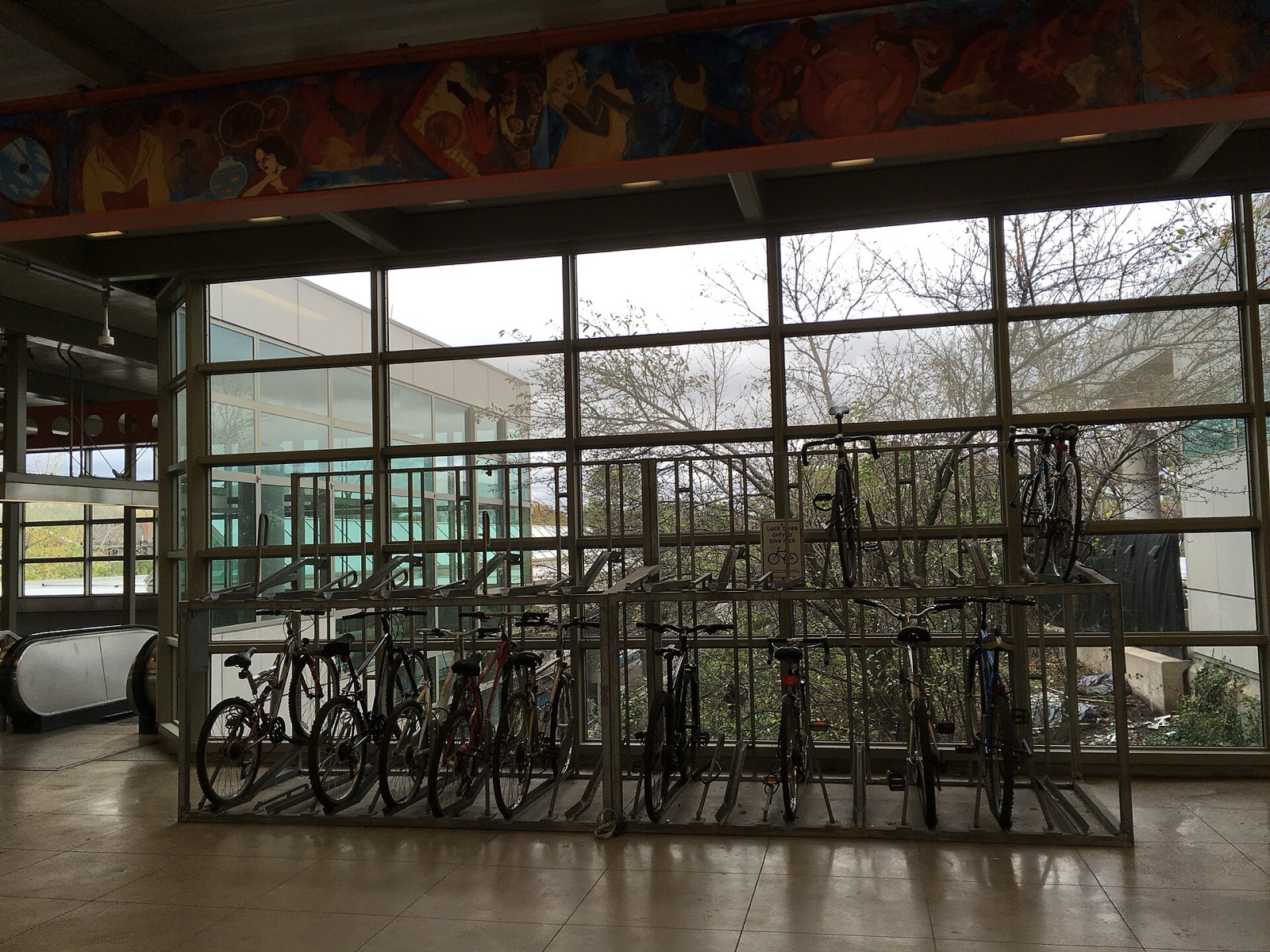
Chicago apartments are tight, and a bike is a bulky guest. The answer depends on what your building offers. Start with the best option, a secure bike room, and work down to the street.
What the zoning code says
The City’s zoning ordinance sets the rules when bicycle parking is required. Whenever it is required, at least 2 bicycle spaces must be provided.1 No use is required to provide more than 50 bicycle parking spaces.1
For residential buildings, required bicycle parking may be provided in garages, storage rooms and other resident-accessible, secure areas.1 Space within dwelling units or on balconies may not be counted toward the requirement.1 The parking may be indoors or outdoors.1 Areas must be paved, drained and well-lighted.1 If the spaces are not visible from the street, signs must show where they are.1
Read that as a floor. A building can offer a better bike room than the code demands, and the best ones do.
The best answer: a building bike room
Active Transportation Alliance calls secure indoor bike storage a good idea for commercial and residential buildings, because many people are not comfortable storing their bikes outside for long periods.2
A good room follows a short list:
- First floor, well-lit and climate-controlled, within 100 feet of an entrance.2
- A door secured with a lock.2
- Racks that accept a U-lock and touch the frame at two points or more.2
- Aisle space, because injuries and damage are more likely when racks sit too close.2
- Outlets for charging e-bikes.2
In a small room, two-tiered and vertical racks with lift assist are optimal for high-density parking.2
Active Trans points to the AMLI 808 apartment complex at 808 N. Wells St. in River North as a good example of a functional bike room. Its two-story bike room has more than 300 bike parking spots, enough for each unit, plus four lockers for electric bikes or larger bicycles.2 One real estate executive estimates about 25 quality bike rooms exist in the Loop and West Loop.2 Ask about the room before you sign a lease.
If your building has none
Bike rooms help buildings stand out and give them an edge with prospective renters.2 Use that. Identify fellow residents who would like a bike room, then work with a rack company to draft a layout and take it to management.2
Inside your unit, basement or garage
The City’s advice is plain: store your bike inside if space is available.3 Garages in Chicago are less secure than basements or living spaces.3
The theft data backs it. Bike Index’s survey found 28% of stolen bikes were taken from sheds or garages, and 66% of those bikes were left unlocked.4 Lock a bike you keep in a garage or on a porch.3 Avoid locking to private property.3
Lock it even in a “secure” room
A bike room reduces risk. It does not end it. Always use at least one high-quality U-lock for the frame and wheels, and keep it locked even in secure rooms or areas.4 Bike Index’s minimum for large cities is two U-locks, or a U-lock and one heavy-duty cable.7 Lock to an immovable object even in a secure place.7 Buy the highest quality lock you can afford.3
Also record your serial number, keep a photo of you with the unlocked bike and keep the sales receipt.3 Register the bike with the Chicago Police Department.3 See bike locks in Chicago and bike theft in Chicago for the full routine.
When there is no space at home
Public parking fills the gap. The City has installed over 15,000 public bike racks and over 80 on-street bike corrals.5 Corrals provide parking for 10 or more bicycles in the same space typically occupied by a single car.5
Bike parking near your building can be requested through CDOT, whose Bike Parking Manager makes a field visit to confirm that rack placement meets CDOT standards.5
At the train, bicycle parking racks are installed outside most ‘L’ stations, and many stations have sheltered outdoor or even indoor bike parking for added security and weather protection.6
For more on parking and buildings, read bike parking downtown and bike-friendly buildings. The Plan a Ride hub has the rest of the guide.
Read next
Bike Locks for Chicago: What to Buy and How to Lock
Chicago needs more than one cheap cable. Which lock types hold up, the two-lock minimum for big cities, and where to lock a bike.
commutingBike Theft in Chicago: Numbers, Hotspots and How to Prevent It
Police counted 1,283 reported bike thefts in Chicago in 2023. Where bikes disappear, how thieves operate, and the locking rules that work.
commutingBike-Friendly Buildings in Chicago: What the Zoning Code Requires
What Chicago's zoning code requires for bike parking in offices, apartments and garages, how to ask for more, and where the city puts public racks.
Questions people ask
Where is the safest place to keep a bike in a Chicago apartment?
Inside. The City advises storing a bike inside if space is available and notes that Chicago garages are less secure than basements or living spaces. Lock it even in a secure room.3,4
Does my building have to provide bike parking?
When the zoning code requires bicycle parking for a residential use, it may be provided in garages, storage rooms and other resident-accessible, secure areas. Space inside a dwelling unit or on a balcony does not count toward the requirement.1
How should a good building bike room be designed?
Active Transportation Alliance's guidance: a first-floor, well-lit, climate-controlled room within 100 feet of an entrance, with a locked door and racks that accept U-locks.2
Sources
- Municipal Code of Chicago 17-10-0300 (Bicycle parking)GOV
City of Chicago Zoning Ordinance (American Legal Publishing) · codelibrary.amlegal.com · checked 2026-10-19 - Making the case for bike roomsNONPROFIT
Active Transportation Alliance · activetransportation.org · checked 2026-10-19 - Bike Theft PreventionGOV
City of Chicago, CDOT · chicago.gov · checked 2026-10-19 - 2025 Bicycle Theft Stats: What you need to know to protect your bikeNONPROFIT
Bike Index · bikeindex.org · checked 2026-10-19 - Bike ParkingGOV
City of Chicago, CDOT · chicago.gov · checked 2026-10-19 - Bike & RideGOV
Chicago Transit Authority · transitchicago.com · checked 2026-10-19 - Protect your bikeNONPROFIT
Bike Index · bikeindex.org · checked 2026-10-19
Photo credits (1)
- Eric Fischer / Wikimedia Commons · CC BY 2.0 · source

Laws are quoted from Illinois statute and the Chicago Municipal Code; prices from each operator on the date shown. Editorial policy · Corrections.