Bike-Friendly Buildings in Chicago: What the Zoning Code Requires
What Chicago's zoning code requires for bike parking in offices, apartments and garages, how to ask for more, and where the city puts public racks.
Chicago's zoning ordinance ties bike parking to a building's use. Any use that must provide it needs at least 2 spaces, never more than 50. Nonresidential spaces measure 2 by 6 feet with 7 feet of clearance and need approved racks. Residential spaces can sit in garages or storage rooms.1
- At a glance
- Minimum
- 2 bike spaces wherever parking is required1
- Maximum
- No use must provide more than 50 spaces1
- Space size
- 2 ft by 6 ft, 7 ft overhead clearance1
- Multi-unit housing
- 1 bike space per 2 auto spaces, 8+ units2
- Public racks
- Over 15,000 racks and 80 corrals3
On this page
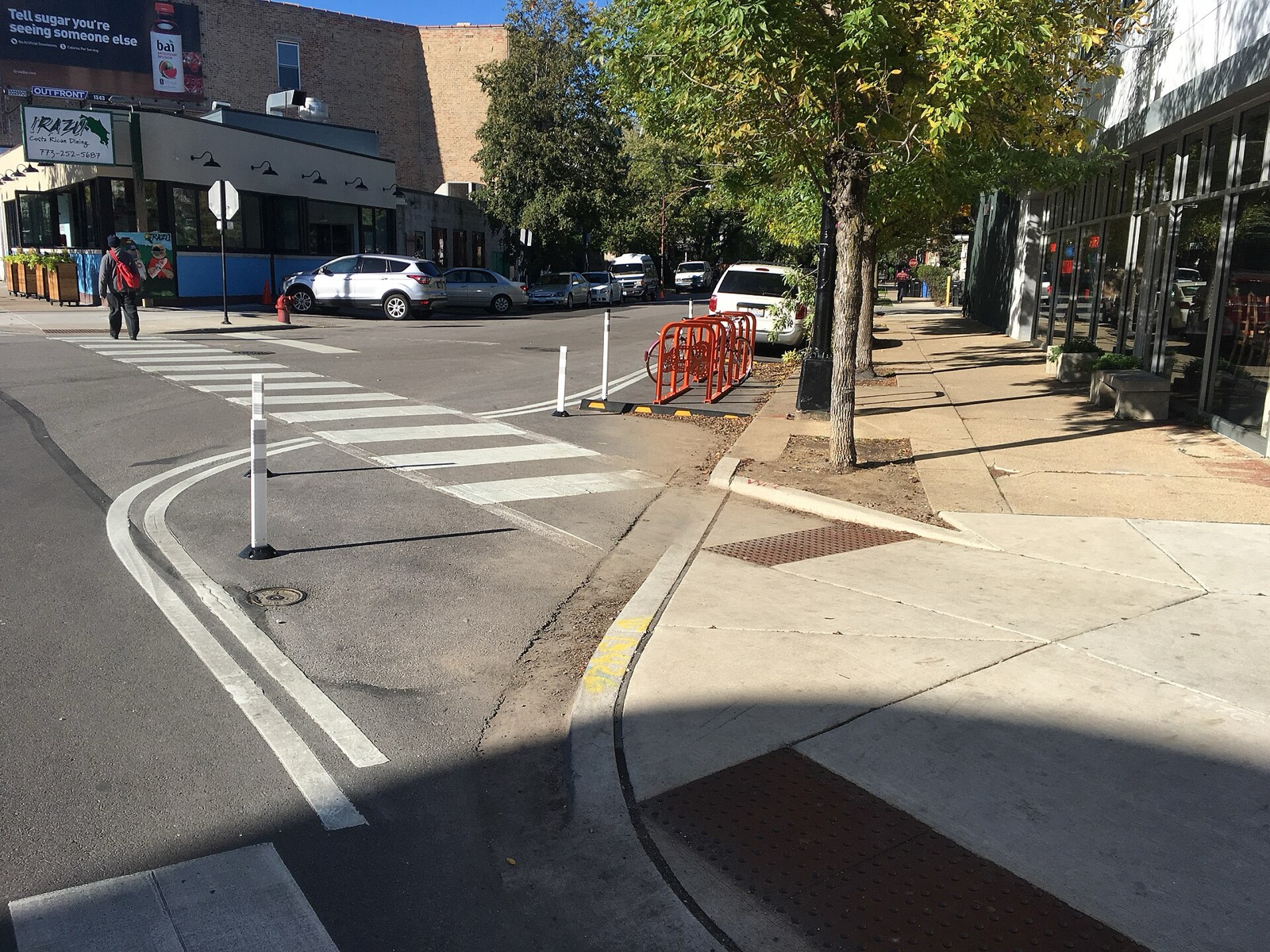
A bike-friendly building has somewhere safe to leave the bike. In Chicago that is partly a matter of law. The city writes bike parking into its zoning code, and the rules decide how many spaces a new building must supply, how big they are and where they can go.
What the ordinance requires
The rule sits in section 17-10-0300 of the Chicago Zoning Ordinance. Bike parking follows the off-street parking ratios of the code’s parking chapter.1
Unless otherwise expressly stated, whenever bicycle parking is required, at least 2 bicycle spaces must be provided.1
Two limits bracket that floor. No use is required to provide more than 50 bike spaces.1 The Zoning Administrator may approve an administrative adjustment that reduces the number a particular use must provide.1
How the count is set
The count is not a flat figure. The final column of each off-street parking schedule sets a minimum bike ratio for its parking group.2 In most cases it is keyed to the number of car spaces the building provides.
| Use (neighborhood districts) | Minimum bike parking |
|---|---|
| Multi-unit housing, 8+ units | 1 per 2 auto spaces2 |
| Single-room occupancy, 8+ units | 1 per 2 auto spaces2 |
| Elderly housing, 8+ units | 1 per 4 auto spaces2 |
| Offices and financial services | 1 per 10 auto spaces2 |
| Hotels and motels | 1 per 10 auto spaces2 |
| Retail and restaurants | 1 per 5 auto spaces2 |
Detached houses, two-flats and townhouses carry no bike requirement.2 Downtown, the schedule sets no automobile minimums in the D-7, D-12 and D-16 districts apart from a few exceptions such as hotels with large meeting space and theaters seating more than 1,000.2
Design and location rules
The ordinance is specific about what counts.
- Size. Nonresidential spaces must be at least 2 feet wide and 6 feet long, with 7 feet of overhead clearance.1
- Racks. Fixtures must be of a CDOT-approved design and affixed to the ground or a building, so a bicycle can be locked to them.1
- Placement. Spaces may be indoors or outdoors, on private property unless the CDOT Commissioner approves the public way.1
- Signs. If the spaces are not visible from the street, signs must show where they are.1
- Surface and light. The area must be paved, drained and well lighted.1
- Car-space swap. A nonresidential use may convert up to 2 required car spaces into bike parking.1
Residential buildings get more latitude. Required spaces may sit in garages, storage rooms and other secure areas residents can reach, and racks are not required.1 Space inside a dwelling unit or on a balcony does not count.1
Garages with lockers
Large public garages carry their own rule. A non-accessory parking facility with more than 250 spaces must provide bike parking equal to 2 car spaces.1 That space must hold lockers, hard covers or shells, or similar devices that let a bike be covered and locked individually.1
Public racks and corrals
Where a building cannot or does not provide parking, the city does. Chicago has installed over 15,000 public racks and over 80 on-street corrals.3 The Bike Parking Program has had a yearly goal of installing hundreds of racks since 1993.3
CDOT recommends an inverted U rack made of galvanized steel.3 A corral gives parking for 10 or more bikes in the space one car usually fills.3 CDOT furnishes and installs a standard red 10-bike corral for $3,300.5 Custom branding typically adds about $700.5 Corrals need a maintenance agreement and aldermanic approval.3
Racks follow siting rules:
- The sidewalk must be at least 10 feet wide.4
- The rack must sit at least 40 feet behind bus stop signs and shelters.4
- It must be at least 6 feet from CTA subway exit portals.4
CDOT generally does not install racks in primarily residential areas.4 Installation takes a few weeks to several months.4 For where to lock up downtown, see bike parking downtown, and for what to lock with, bike locks for Chicago.
Where the ordinance stops
In 2014 Active Transportation Alliance said many buildings still lacked secure bike parking, and that the Building Owners and Managers Association was inclined to let the market decide.6 The group noted that San Francisco and New York adopted ordinances requiring secure parking at certain office buildings, waived where the building lets tenants bring bikes into their offices.6
If you commute, ask your property manager. The group wrote that more buildings were providing secure parking at the behest of current and prospective tenants.6 Secure parking matters most when a bike sits for 8 hours or more.6 Employers have their own reasons to supply it, laid out in why employers should promote bike commuting. The rest of the guides are in the commuting hub.
Read next
Bike Parking Downtown Chicago: Racks, Corrals and Locking
Where to park a bike downtown: city racks and corrals, CTA station parking, how to lock, and why the Millennium Park indoor bike station is gone.
commutingBike Locks for Chicago: What to Buy and How to Lock
Chicago needs more than one cheap cable. Which lock types hold up, the two-lock minimum for big cities, and where to lock a bike.
commutingWhy Employers Should Promote Bike Commuting
The case for employers to back bike commuting: sick-day data, long-term health, morale, and the tax change ending tax-free bike reimbursements.
Questions people ask
Does Chicago require bike parking in new buildings?
Yes. The zoning ordinance ties bike parking to the building's use. Wherever it is required, a building must provide at least 2 spaces, and no use must provide more than 50. The Zoning Administrator can approve a reduction.1
How big must a required bike parking space be?
For nonresidential uses, 2 feet wide by 6 feet long with at least 7 feet of overhead clearance. Racks must be CDOT-approved and fixed to the ground or a building so a bicycle can be locked to them.1
Can apartment buildings use storage rooms for bikes?
Yes. Residential bike parking may go in garages, storage rooms and other secure areas residents can reach. Racks are not required for it. Space inside dwelling units or on balconies does not count toward the requirement.1
Sources
- 17-10-0300 Bicycle parkingGOV
Chicago Zoning Ordinance (American Legal Publishing; via Wayback) · codelibrary.amlegal.com · checked 2026-10-19 - 17-10-0200 Off-street parking ratiosGOV
Chicago Zoning Ordinance (American Legal Publishing; via Wayback) · codelibrary.amlegal.com · checked 2026-10-19 - Bike ParkingGOV
Chicago Department of Transportation · chicago.gov · checked 2026-10-19 - Bike Parking: Frequently Asked QuestionsGOV
Chicago Department of Transportation · chicago.gov · checked 2026-10-19 - Bike Corrals: Frequently Asked QuestionsGOV
Chicago Department of Transportation · chicago.gov · checked 2026-10-19 - Tell us where you need secure bike parking (2014)NONPROFIT
Active Transportation Alliance · activetransportation.org · checked 2026-10-19
Photo credits (1)
- Eric Fischer / Wikimedia Commons · CC BY 2.0 · source

Laws are quoted from Illinois statute and the Chicago Municipal Code; prices from each operator on the date shown. Editorial policy · Corrections.