Bike Stations in Other US Cities: Where Chicago's 2004 Station Fit
The bike station model, from Long Beach in 1996 to Chicago's 2004 Millennium Park station: who ran them, what they cost, and how secure parking works now.
A bike station is a secure bicycle parking facility, often with showers, lockers and repair. The first US Bikestation opened in Long Beach in 1996. Berkeley and Palo Alto followed in 1999, Seattle in 2003, and Chicago's Millennium Park station in July 2004.1,2,3,4
- At a glance
- First US Bikestation
- Long Beach, 19962
- Chicago's station opened
- July 20044
- Typical membership
- $12 a month or $96 a year2
- Chicago's closing
- September 30, 20226
- Largest in the world
- Utrecht, 12,500 bikes1
On this page
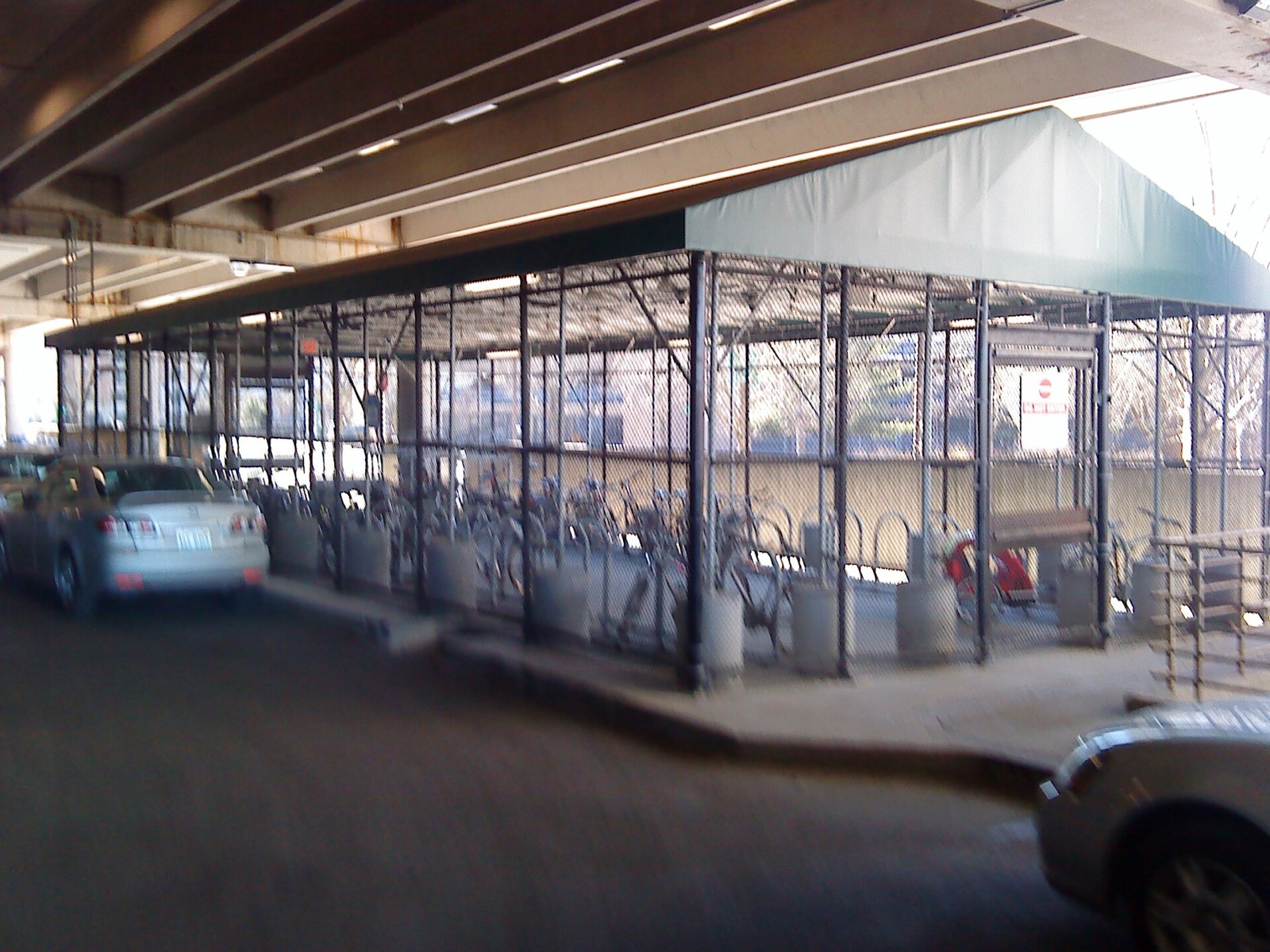
The Millennium Park bike station was never alone. It was one of a small family of secure bike facilities that began on the West Coast and spread to transit hubs and downtowns. This page places Chicago’s station in that family.
What a bike station is
A bicycle parking station, also called a bike garage or cycle center, is a building or structure designed as a secure bicycle parking facility.1 It can be as simple as a lockable cage or as complex as a purpose-built multi-level building.1
Some add repairs, showers or lockers.1 Some are staffed and some are not. Some require membership, while others are per-use or free.1 Operators vary too: local governments, bike shops and nonprofit advocacy groups all run them.1
How the model spread in the United States
The first Bikestation, a trademarked name for a facility with secure storage, repair and often restrooms and showers, opened in Long Beach in 1996.2 The concept was modeled on facilities in Europe and Japan.2 Long Beach built the first bike-transit center in North America in 1996, and a new state-of-the-art facility replaced it in 2006.3
Growth was slow. Palo Alto and Berkeley opened in 1999, and Seattle in 2003.2 Santa Barbara, Claremont and Covina followed, and Washington, D.C. got a Bikestation at Union Station with about 125 indoor parking spaces.2
| City | Milestone |
|---|---|
| Long Beach, CA | First Bikestation, 1996; replacement facility, 20062,3 |
| Palo Alto and Berkeley, CA | Opened 19992 |
| Seattle, WA | Opened 20032 |
| Chicago, IL | Millennium Park station opened July 20044 |
| Washington, D.C. | Union Station Bikestation, about 125 indoor spaces2 |
Where Chicago fit
Chicago began designing its station in August 2003.4 The city built it at the intersection of East Randolph Street and Columbus Drive.4 Bike stations were in place or planned in several US cities, among them Denver, Los Angeles, Berkeley, Long Beach and Palo Alto.4 Facilities with amenities had first appeared on the West Coast and did not yet exist in the Midwest.4
The station opened in July 2004.4 Former Mayor Richard M. Daley celebrated the opening, calling it the “first of its kind in the Midwest and one of the biggest in the nation.”7 The plan behind it is in the Bike 2010 plan page, and the building’s story is in the station history.
What Long Beach offered
The Long Beach facility is the best documented template. Its services included:
- Secure, indoor 24/7 bike parking.3
- Valet bike parking during staffed hours.
- Bicycle repairs, rental and retail.
- Tools and repair stands free of charge.
- Educational classes on bike maintenance, routes, rights and responsibilities.
What it cost to use one
Full use, including around-the-clock parking, typically cost a membership of $12 a month or $96 a year plus a $20 annual administrative fee.2 Long Beach offered the same $12 and $96 rates and a $1-a-day option.3
Phase one of the new Long Beach building cost about $450,000.3 Its operating costs were $130,000 a year, of which the City of Long Beach contributed $48,000 a year while fees for Bikestation services covered the balance.3
In user surveys, 30 percent of users previously drove alone to their destinations.3 In 2006 Bikestation parked over 50,000 bikes.3
Why a station can still fail
Chicago’s station closed permanently on September 30, 2022.6 The City said it ended the operator’s contract because the station was not sustainable as a business enterprise, with decreased demand for its amenities in that location.6 The building will now be a home for the Chicago Police Department Bicycle Patrol.6
Secure parking today
The world’s largest bicycle parking station is at Utrecht Railway Station in the Netherlands, completed in 2019, with room for 12,500 bicycles on three levels of double-decker racks.1
New York City’s Department of Transportation provides free, short-term bike parking.5 Each of its bike shelters contains four racks and protects bikes from the rain.5 Secure parking is a separate program: a network of 500 locations available through paid memberships.5
For parking a bike in Chicago today, see the Station hub and the guide to bike parking downtown.
Read next
McDonald's Cycle Center History: Chicago's Millennium Park Bike Station
How Chicago built the Millennium Park bike station in 2004, named it for McDonald's in 2006, handed it to Shift Transit in 2021 and closed it in 2022.
stationChicago's Bike 2010 Plan: From Bike 2000 to Bike 2015
The Bike 2010 plan behind the Millennium Park bike station: the Bike 2000 plan before it, the Bike 2015 plan after it, and what Chicago set out to build.
commutingBike Parking Downtown Chicago: Racks, Corrals and Locking
Where to park a bike downtown: city racks and corrals, CTA station parking, how to lock, and why the Millennium Park indoor bike station is gone.
Questions people ask
What is a bike station?
A building or structure designed as a secure bicycle parking facility. It ranges from a lockable cage or shed to a purpose-built multi-level building, and some add repairs, showers or lockers.1
Where was the first bike station in the United States?
Long Beach, California. The first Bikestation opened there in 1996, and a state-of-the-art facility replaced the original in 2006.2,3
How much does a bike station cost to use?
Bikestation memberships for around-the-clock parking typically ran $12 a month or $96 a year, plus a $20 annual administrative fee. Long Beach also offered a $1 daily rate.2,3
Where is the biggest bicycle parking facility in the world?
The station at Utrecht Railway Station in the Netherlands, completed in 2019. It holds 12,500 bicycles on three levels of double-decker racks.1
What happened to Chicago's Millennium Park bike station?
It closed permanently on September 30, 2022. The building will now be a home for the Chicago Police Department Bicycle Patrol.6
Sources
- Bicycle parking stationREFERENCE
Wikipedia · en.wikipedia.org · checked 2026-10-19 - 'Bikestations' proliferate as motorists switch to two wheelsNONPROFIT
Public Square: A CNU Journal (Congress for the New Urbanism) · cnu.org · checked 2026-10-19 - Bikestation Long BeachNONPROFIT
Pedestrian and Bicycle Information Center · pedbikeinfo.org · checked 2026-10-19 - McDonald's Cycle CenterREFERENCE
Wikipedia · en.wikipedia.org · checked 2026-10-19 - Bicycle ParkingGOV
NYC Department of Transportation · nyc.gov · checked 2026-10-19 - Confirmed: Millennium Park bike station will now only serve cops instead of commutersPRESS
Streetsblog Chicago · chi.streetsblog.org · checked 2026-10-19 - Millennium Park bike station closing at end of monthPRESS
FOX 32 Chicago / Sun-Times Media Wire · fox32chicago.com · checked 2026-10-19
Photo credits (1)
- CaribDigita / Wikimedia Commons · Public domain · source

Laws are quoted from Illinois statute and the Chicago Municipal Code; prices from each operator on the date shown. Editorial policy · Corrections.