Bikes on CTA Buses: How to Use the Front Rack
Load a bike on a CTA bus in seven steps: lower the rack, seat the wheel, drop the arm. Plus what stays off the rack and how to recover a forgotten bike.
CTA buses carry bikes on a front rack. Tell the driver, lower the rack, set the bike in the wheel well, then pull the support arm over the front wheel. Bags come off first. The rack is open at rush hour, when trains are not. Divvy bikes are not allowed.1,2
- At a glance
- Where bikes ride
- Front-mounted rack1
- Before loading
- Remove bags and panniers1
- Rush hour
- Crowding limits do not apply to bus racks1
- Minimum age
- 14, or 12–13 with an adult1
- Practice rack
- 567 W. Lake St.3
- Divvy bikes
- Not allowed1
On this page
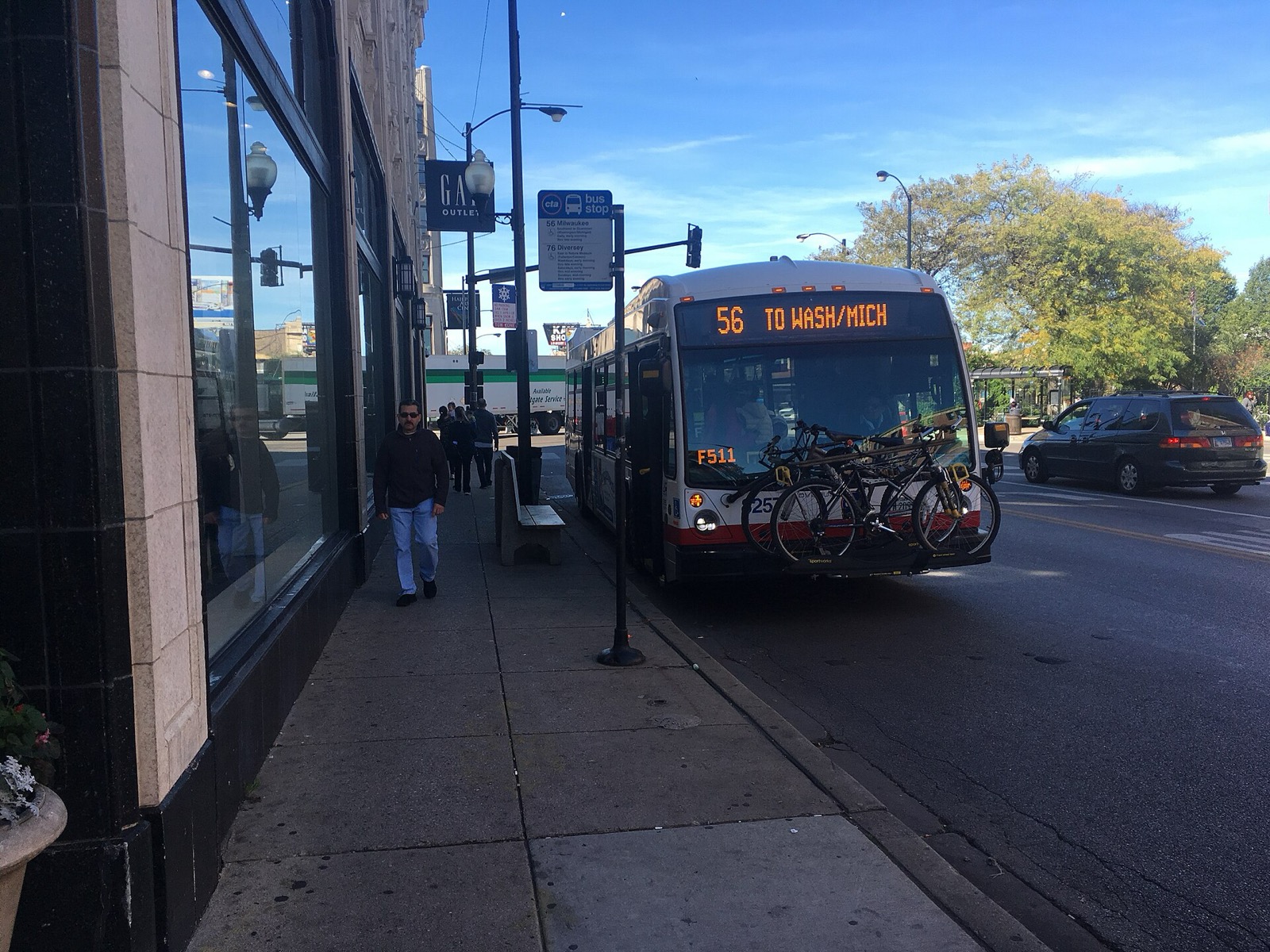
The bus rack is the bike option that works when nothing else does. It runs where the L does not, and it stays open when the trains close to bikes. Learn the routine once and it takes seconds.
The front rack
CTA and Pace buses carry bikes on a rack on the front.2 A spring-loaded arm swings over the front wheel and holds the bike in place while the bus moves.1
The rack is the answer to a crowded train. The CTA says crowding restrictions do not apply to bus racks, and it tells riders to treat the bus as the backup plan whenever a train cannot take the bike safely.1 The weekday rush-hour limits on trains are covered in bikes on CTA trains.
Loading, step by step
- Strip the bike. Take off bags and anything that hangs, panniers included, before the bus arrives.1
- Tell the driver. Signal that you are loading a bicycle.1
- Lower the rack. If yours is the first bike, squeeze the center handle.1
- Seat the bike. Lift it into the empty wheel well closest to the bus. A first bike goes in with the front wheel toward the curb, where the support arm sits. A second bike faces away from the curb.1
- Secure the arm. Pull the support arm out, then up and over the front wheel until it rests where the wheel meets the fork.1
- Board and pay. Sit or stand near the front so the bike stays in view.1
- Unload. Exit at the front and tell the driver you are removing a bike. Lower the support arm, lift the bike off, and, if the rack is now empty, squeeze the handle and fold it back up.1
If you worry about theft, lock the front wheel to your frame. Never lock the wheel or the bike to the rack.1
Practice before you commute. The CTA installed a demonstration rack outside its building at 567 W. Lake St. so riders can see how the process works.3
What goes on a bus and what does not
| Item | On a CTA bus |
|---|---|
| Bicycle on the front rack | Allowed, riders 14 and older alone1 |
| Riders 12–13 with a bike | Allowed with an adult1 |
| Riders under 12 with a bike | Not allowed1 |
| Folding bike | Allowed inside at all times1 |
| Folded e-bike or scooter | Allowed inside1 |
| Divvy bike or scooter | Not allowed1 |
| Gas-powered bike | Prohibited1 |
Bikes on CTA property must be less than 72 inches long and no more than 30 inches wide.1 The owner carries the risk: a cyclist assumes all responsibility for damage or injury caused by the bike.1
If you leave a bike behind
It happens. A forgotten bike will likely end up at the garage the bus came from, in that garage’s Lost & Found. The CTA points to its Lost & Found page and says to call the next day. Some routes draw buses from more than one garage, so confirm which one served your route.1
Using the bus to reach a ride
Buses fill the gaps the L leaves. The CTA points riders to numerous east-west bus routes for the Lakefront Trail.1 For Calumet Park and the Burnham Greenway to the south, it suggests the Red Line to 69th, then the #30 bus to 95th.1 See Burnham Greenway for the trail itself.
Heading beyond the city? Read bikes on Metra. For the rest of the commuting toolkit, from parking to routes, start at the commuting hub and the Chicago bike commuting guide.
Read next
Bikes on CTA Trains: Hours, Limits and Etiquette
When you can bring a bike on the CTA L, the two-bike car limit, the rush-hour blackout, which gates to use, and what stays off the train.
commutingBikes on Metra: Rules, Bike Cars and What to Expect
Metra allows bikes on every train at no charge. Where they go, how to secure them, the 80-inch limit, the age rule and the new e-bike carry rule.
commutingBike Commuting in Chicago: A Beginner's Guide
How to start commuting by bike in Chicago: the network, where to ride, the lighting rule, a pre-ride check, and how to combine the bike with CTA.
Questions people ask
How do I put a bike on a CTA bus?
Strip off bags, tell the driver, and lower the rack if yours is the first bike. Lift the bike into the wheel well, pull the support arm over the front wheel, then board and pay. At your stop, tell the driver before you unload.1
Can you put a bike on a bus rack during rush hour?
Yes. The rush-hour ban applies to trains. The CTA says crowding restrictions do not apply to bus racks and tells riders to treat the bus as the backup when trains are too full.1
Can I lock my bike to the bus rack?
No. You may lock your front wheel to your own frame, but the CTA prohibits locking the wheel or bike to the rack. Sit near the front where you can see the bike.1
What if I leave my bike on a CTA bus?
Call the next day. A forgotten bike will likely end up at the garage the bus came from, in its Lost & Found. Some routes use more than one garage, so check which one served your route.1
Do Pace buses have bike racks?
Yes. Both CTA and Pace buses carry front bike racks, and both allow folding bikes on board.2
Sources
- Bike & RideGOV
Chicago Transit Authority · transitchicago.com · checked 2026-10-19 - Bikes on transitNONPROFIT
Active Transportation Alliance · activetransportation.org · checked 2026-10-19 - Practice putting your bike on a busNONPROFIT
Active Transportation Alliance · activetransportation.org · checked 2026-10-19
Photo credits (1)
- Eric Fischer / Wikimedia Commons · CC BY 2.0 · source

Laws are quoted from Illinois statute and the Chicago Municipal Code; prices from each operator on the date shown. Editorial policy · Corrections.